10 March 2009

Thousands of Burundians turn out for anti-gay demo

BUJUMBURA (AFP) — Thousands of Burundians took part in a government-organised demonstration Friday to demand that homosexuality be criminalised.

Between 10,000 and 20,000 people turned out, according to varying estimates, to protest the senate's decision not to criminalise homosexuality, in the largest demonstration since President Pierre Nkurunziza came to power in 2005.
Read the full AFP article. We were at home having lunch that afternoon while this was going on so we didn't get to see it when it passed by Mike's office. Apparently it was a peaceful demonstration, so despite what they were demonstrating for, it may have been the most peaceful large demonstration in the country's history.

There's been discussion about whether homosexuality should be a crime in Burundi. It's a religious conservative country and many people believe that it's not just a sin, but should be punishable by law. Incidentally, at the same time the homosexuality bill was brought up, the government passed a law abolishing the death penalty. Yay! Look, no death penalty! We'll just try to sneak this anti-human-rights bill through while everyone's distracted by the death penalty abolishment.

09 March 2009

One of my worst nightmares

When we returned from vacation, two weeks away, we found that Grendel (a 20-pound Norwegian forest cat) had lost weight. A lot of it. Nearly half of his body weight. We know our housekeeper had been coming to feed the cats while we were gone and the other one was perfectly healthy.

Coming home to a sick pet is traumatic enough, but in Burundi its worse than if our house had been robbed. I felt empty and helpless and incredibly guilty. There's a veterinary clinic here, but it's for livestock. Vet care here consists of knowing when it's time to put down a sick cow or goat so it doesn't infect the rest of the herd. But we know someone who'd taken their dog to the clinic and the dog recovered. What other choice did we have? 

The vet was very nice and everyone in the office told us how "joli" (beautiful) he is. Even with his diminished weight, he's a large, good-looking cat. No one in the office spoke English but Mike managed in French to say how big he'd been before we left for vacation. They couldn't do much for him, but they tried. They took his temperature and tested him for worms. They gave him a deworming pill and an antibiotic shot. They really didn't know what was wrong with him, but that was pretty much all they could do. He had a slight fever, which indicated infection. They asked us to come back the next day for another antibiotic shot.

On that day we came home, our flight was early in the morning and we had that whole day off from work. Mike got called in, but I spent a long afternoon at home worrying over Grendel and observing him. To my relief, around dinner time he got up and ate a little bit and drank some water. His personality was returning, too, and he jumped up onto the couch with me. The next morning, he was eating more food.

We took him back to the vet at lunch time. His temperature had returned to normal. She gave him another antibiotic shot. We didn't have time to bring him back to the house so he hung out in my office for the afternoon. He continued to eat and drink water in near-average quantities.

By that night it seemed like his old self was all the way back. He was even begging for food. We are incredibly lucky that whatever it was appears to have been a simple infection. He's a middle-aged cat and he was slightly overweight. If he has kidney problems or diabetes complications, there's nothing that could be done for him here. 

Now, two weeks later, he's gained some weight back. It will take awhile for him to beef up completely, and it would be better for his health if he stays closer to 17 or 18 pounds rather than 20. He's still so handsome.

(A collection of Grendel pics.)

08 March 2009

Dr. Livingstone, I presume?

Yes, that's a cliche title to a post about visiting the Livingstone Monument. Stanley and Livinstone's first meeting wasn't even in Burundi, it was in Tanzania (although many people who don't know that assume it was here when they see there's a monument). 

They traveled through Burundi and spent several hospitable days in Mugure, a village just south of Bujumbura. When we arrived yesterday I could see why they wanted to spend several days there. The view is gorgeous. You've got mountains behind you, a river immediately in front of you and Lake Tanganyika in the distance. Beyond the lake, more mountains from the Congo.

Livingstone carved their names on a large rock overlooking the river. And that's the monument. It's quite simple and I think some people are disappointed by it.

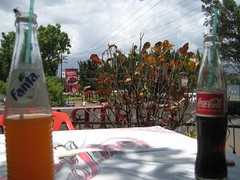
But when I was planning an excursion for some folks at work I needed a way to make it less disappointing. The spot is wonderful for a picnic. There used to be a bar there but it closed down during the war. The buildings were abandoned but still standing. And "buildings" is a generous term. They are huts with short walls and thatched roofs, so you can enjoy the view and be out of the sun. I told people to pack a lunch and I'd provide a cooler of beverages. Primus anyone? We had beers and Cokes and hung out for over an hour just enjoying the view and the breeze. 

There are some children there who will hang around. There's a police post there, and the police will chase the kids away after awhile hoping to get a tip from you for that task. We didn't give anything to the police officers, but when we left we gave lollipops and pencils to the kids.

It was nice to be outside the city for a couple hours.


07 March 2009

I've also blogged at bit at What I Eat this week.

A jungle alliance that may just endure

Mar 5th 2009 | GOMA AND KIGALI
From The Economist print edition


Two rival countries have joined forces to hammer the militias that have devastated eastern Congo for so long

SCRUFFY but happy, Timothy is keen to talk about his new life in Rwanda. A former captain in a guerrilla army across the nearby border in the dense jungles of eastern Congo, he has spent most of his life fighting against the present government of Rwanda. Now, however, he has turned himself in and gone back to the land of his birth, where he is on a two-month course run by his former adversaries to reintegrate him into Rwandan society.

He starts early every morning, packing in six hours of “discussion” on such topics as patriotism, the history of Rwanda, and “the role of youth in national development”, before breaking for football. Timothy realises that he must “forget everything about guns” and “learn to co-operate with civilians”. He is learning a lot of other useful stuff too. “Men used to beat women,” he says, but apparently you cannot do that any more. “When she is wrong, you have to talk to her, not treat her like a goat.”

Timothy’s re-education at the Mutobo demobilisation centre near Ruhengeri in north-west Rwanda is the best hope in years that the long, devastating conflict between Rwanda and Congo may be abating. He and hundreds like him are being persuaded to give up their arms by the force of a new alliance between the two old foes. If this new alignment of military and political power eventually leads to peace in the region, the Rwandan genocide of 1994 may at last cease to cast its long shadow over the Great Lakes region (see map).


Read the full article at The Economist. This is the kind of news we keep an eye on, since it's all happening so close to us and it involves the same ethnic groups as the war in the 1990s here.

05 March 2009

One More Day

Are you tired of hearing about Tanzania yet? I have one more day to blog about.

The food that Zara Tours provided us was not terrific. Most nights it wasn’t bad and one night it was even pretty good. Some dishes were utterly inedible though, and some of those dishes were served to us at nice hotels, not dinners at high altitude when everything made us feel nauseous. What was annoying was that most of the dishes were local interpretations of Western-style food. Most of the tourists were American or German and they seemed to be okay with pizza topped with sardines and the same vegetable soup every single night. What’s wrong with you people? We had been hoping for some African food. We like it! And we also had our hearts set on amazing coffee, but the coffee served by Zara, even in the hotels, was dishwater.

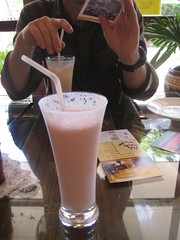
So on our very last day in Tanzania we went back into Moshi in search of coffee and African food. Our safari guide pointed out a restaurant and we had seen and heard of a couple others we wanted to check out. First, coffee. We had been in search of coffee the last time we were in Moshi but every coffee shop we passed was closed. The same was true on this day. What’s up with that? Finally we were driven inside by thirst, heat, and visions of ice cream at an Indian restaurant called Deli Chez. (Yeah, and remember the Salzburger CafĂ© was full of Volkswagen iconography.) First we each ordered a milkshake. Milkshakes! It had been ages since we’d had milkshakes. Mine tasted like strawberry Quick rather than strawberry ice cream, but I didn’t care. I loved it. Then I ordered a hot coffee and Mike ordered an iced coffee. It wasn’t the best Tanzanian coffee I’d ever had, but it was a million times better than what I’d been drinking for the previous two weeks.

IMG_2747.JPG
Milkshakes at Deli Chez

We still wanted African food, but we were full of beverages so we decided to walk for a bit. We found some relatively quiet and shady roads leading away from the crowded downtown area and just wandered around. When we finally got hungry, we walked back into town to the restaurant our driver had pointed out for local food: Central Garden.

IMG_2750.JPG
Central Garden

We got the African menu, but the muzungu prices. (It was still pretty cheap, but no matter how much long we live in Burundi, we will never get the local prices.) Mike ordered ugali with beef and I ordered ugali with chicken. (Actually I ordered bananas, but they were out of bananas!) The food was okay. It wasn’t the greatest but it was a nice change from the hotel food we’d been eating. And the mango-passionfruit juice for dessert was yuuuummmmmeeeeee.

Eventually we went back to the hotel for the night. We had to leave at 4 am the next day to make a 6 am flight. We skipped the hotel’s dinner, preferring to snack on Lara bars rather than face that food one last time.

We had an uneventful trip home. And that about brings us up to speed.


The Invisible War

By BOB HERBERT
OP-ED COLUMNIST
Published: February 21, 2009

Perhaps we’ve heard so little about them because the crimes are so unspeakable, the evil so profound.

For years now, in the Democratic Republic of Congo, marauding bands of soldiers and militias have been waging a war of rape and destruction against women. This sustained campaign of mind-bending atrocities, mostly in the eastern part of the country, has been one of the strategic tools in a wider war that has continued, with varying degrees of intensity, since the 1990s. Millions have been killed.

Women and girls of all ages, from old women to very young children, have been gang-raped, and in many cases their sexual organs have been mutilated. The victims number in the hundreds of thousands. But the world, for the most part, has remained indifferent to their suffering.

“These women are raped in front of their husbands, in front of their children, in front of their parents, in front of their neighbors,” said Dr. Denis Mukwege, a gynecologist who runs a hospital in Bukavu that treats only the women who have sustained the most severe injuries....

Despite the presence in the region of the largest U.N. peacekeeping mission in the world, no one has been able to stop the systematic rape of the Congolese women.

If these are not war crimes, crimes against humanity, then nothing is.

Read the full column at the New York Times.

I know it's a hard read, but it's a good one.